Robot demo, pilot or deployment: what evidence should you ask for?
A practical checklist for interpreting robot demonstrations and comparing task capability, human assistance, operating conditions and sustained use.
 ROBOTICS TODAYEmail launch list
From demonstration to deployment.
A reported aerial rescue and commercial forestry operations anchor this morning’s briefing. New industrial arms, predictive manipulation research and Digit 5’s safety design show how task requirements shape the path from demonstrations to useful machines.
AI-assisted summaries and analysis, with linked sources. No firsthand testing is claimed. How we prepare the briefing
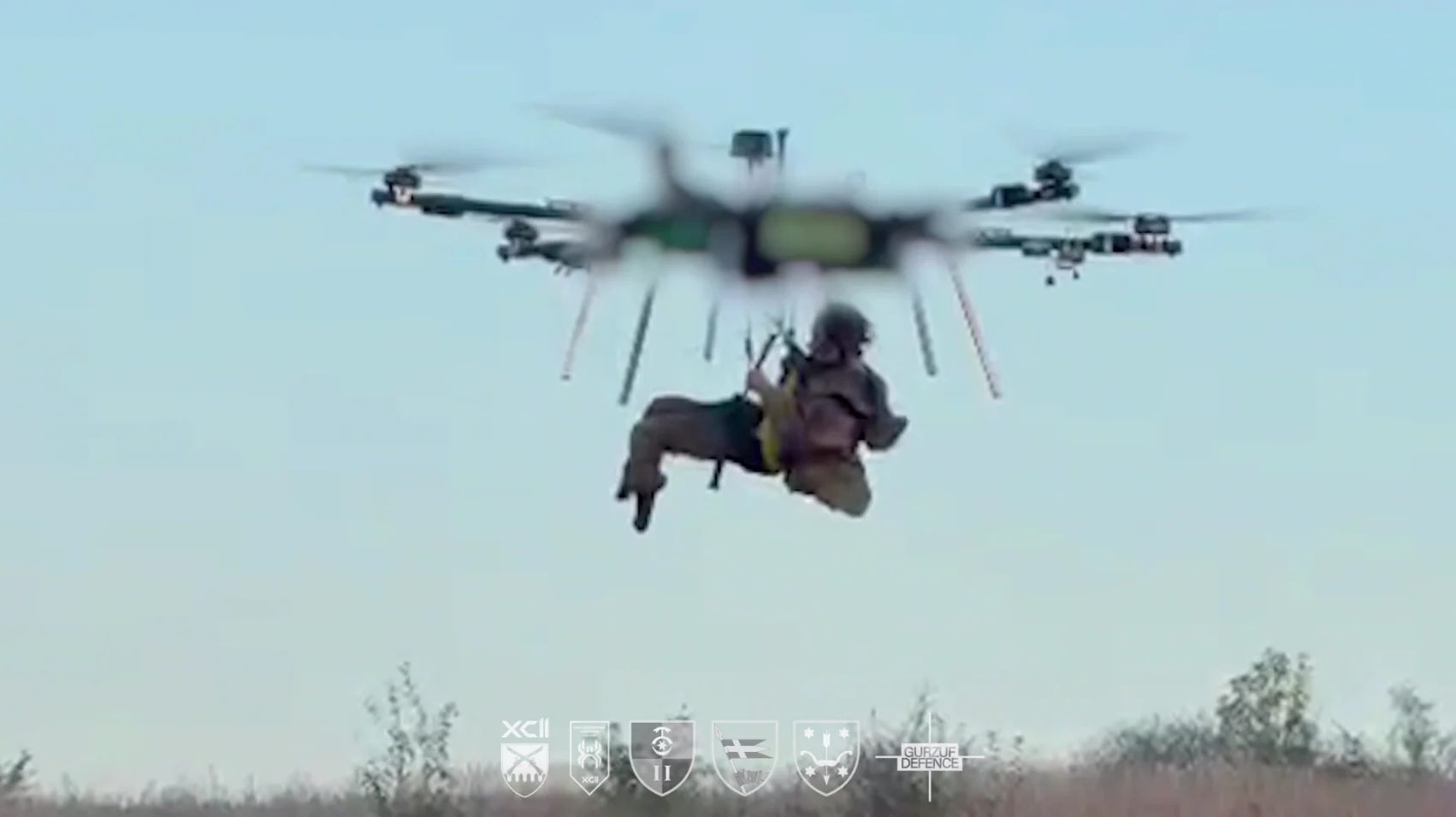
DroneLife reports that Ukraine’s 92nd Separate Assault Brigade announced evacuating a wounded soldier using a modified Gurzuf Defence heavy-lift hexacopter. Ground access was threatened by mines and enemy drones; modifications addressed stability while carrying a person.
Our take The reported mission identifies a concrete rescue role where ground vehicles could not safely reach the casualty. Repeatable medical evacuation will depend on secure patient attachment, stable flight and failure procedures; one successful operation cannot establish routine capability.
DroneLife · Source published
Based on accessible article text
Seoul National University researchers report that Dynin-Robotics achieved 78.4% average success across four physical manipulation settings, including fruit movement and ordered block stacking. The preprint describes a unified model that predicts future scenes and generates robot actions.
Our take Predicting the intended scene offers a way to connect instructions with action selection. For logistics developers, the next meaningful test is handling broader objects and operating conditions, since the reported advantage comes from predetermined experimental settings.
Tech Xplore · Source published
Based on accessible article text
ABB introduced the IRB 1700 and IRB 1700ID, offering 6–12 kg payloads across five variants. Robotics & Automation News reports a working welding and sanding exhibition demonstration; ABB claims cycle times up to 20% shorter than comparable robots.
Our take For integrators, the demonstrated welding and sanding applications provide specific starting points for evaluation. The purchasing question is whether ABB’s cycle-time advantage holds for the buyer’s actual path, payload and tooling, beyond the exhibition configuration.
Robotics & Automation News · Source published
Based on accessible article text
Writing in IEEE Spectrum, Agility cofounder Jonathan Hurst describes Digit 5’s design for lifting 23-kilogram bins. Its planned safety response to approaching people includes setting down its load, sitting and cutting motor power; Digit 4 deployments required barriers.
Our take For warehouse operators, removing physical separation could change where bin-moving robots fit. However, stopping and sitting whenever someone approaches makes pedestrian traffic a consequential operating condition: shared-space usefulness depends on how frequently that protective sequence interrupts work.
IEEE Spectrum · Source published
Based on accessible article text
The Robot Report says Kodama’s technology is operating commercially on logging skidders in the southeastern United States. The company reports moving more than 100,000 tons of timber over six months using teleoperation combined with supervised autonomy.
Our take Kodama’s deployment offers forestry contractors a concrete adoption model: automate repeatable hauling while experienced operators remotely handle difficult situations. The reported timber volume demonstrates work performed, but does not separate autonomous operation from human control.
The Robot Report · Source published
Based on accessible article text
A practical checklist for interpreting robot demonstrations and comparing task capability, human assistance, operating conditions and sustained use.